Training for Rock Climbing
Here is a pretty good video and article on training for climbing. It's pretty hardcore, but quite clear and helpful. Not sure how many folks want to train this hard, but a few will. :-)
From http://www.climbonsister.com/2012/11/training-tuesdays-week-9-guest-post_13.html
This week's Training Tuesday is a guest post from Galina Parfenov, Moon Climbing athlete and bouldering fanatic. Galina started climbing about 5 years ago and hasn't stopped since. She's a seasoned climbing competitor and climbs 3 or 4 days a week, and plans to achieve her first V10 this year!
Because of this dedication, Galina knows a thing or two about training for climbing, which is why I quickly said yes when she asked if she could write a guest post for Climb On, Sister!
So you want to get stronger? Read on...P.S. there's a nice video at the end (by Galina) on how to train for climbing. Get psyched!!! Oh, and be sure to check out Galina's blog here.
***A note to climbers, the exercises in this post are slightly advanced but you can always tailor them to fit your physical abilities.
 To train or not to train? That is the question. Well, at least the question climbers ask themselves after reaching yet another plateau, unable to break that 5.10, 5.12, V8, or whatever-grade-it-happens-to-be barrier. On one hand, if done correctly, training guarantees strength gains. On the other, strength gains don’t necessarily translate to progression in terms of climbing, and training often just seems like a sure way to injuries. And besides, don’t we all want to be the next Chris Sharma, and live by Golden Rule that climbing is the best training?

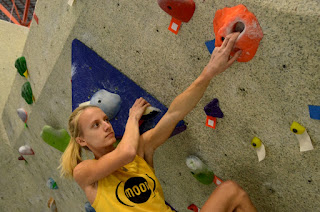


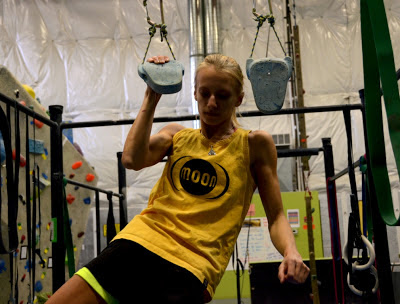
 Power endurance is to bouldering as normal endurance is to sport climbing. You need it. Especially come time for competition season, and you find yourself in the dreaded 4 minutes on, 4 minutes off situation, scrambling to get up the problem. Endurance is something that is often overlooked by boulderers, myself included, because progress isn’t as immediately visible as with strength training. Fortunately, endurance training can be (relatively) quick and painless.
Because of this dedication, Galina knows a thing or two about training for climbing, which is why I quickly said yes when she asked if she could write a guest post for Climb On, Sister!
So you want to get stronger? Read on...P.S. there's a nice video at the end (by Galina) on how to train for climbing. Get psyched!!! Oh, and be sure to check out Galina's blog here.
***A note to climbers, the exercises in this post are slightly advanced but you can always tailor them to fit your physical abilities.
 To train or not to train? That is the question. Well, at least the question climbers ask themselves after reaching yet another plateau, unable to break that 5.10, 5.12, V8, or whatever-grade-it-happens-to-be barrier. On one hand, if done correctly, training guarantees strength gains. On the other, strength gains don’t necessarily translate to progression in terms of climbing, and training often just seems like a sure way to injuries. And besides, don’t we all want to be the next Chris Sharma, and live by Golden Rule that climbing is the best training?
Coming from a gymnastics background, training always seemed like the logical compliment to laidback gym sessions. I did not, however, immediately put on a weight vest and knock out dozens upon dozens of pull-ups on micro-crimps. I did occasional pull-ups, first on a pull-up bar, then on the jugs of a hangboard (I could barely do 5 before I started climbing!) I traversed around the gym and did pyramids, trying to improve power endurance. Above all, however, I focused on technique. I learned about heel-hooks, toe-hooks, flags, back-flags, smearing, stemming, and all the other terms embedded in climber dialect. I learned to keep my feet silent as my hands moved from hold to hold and to keep my arms straight whenever possible. So no, I was not always a masochistic training fanatic. And as for the training question—if you’ve staggered across the dreaded plateau and you’ve been climbing for at least a year, then yes, training can help. It’s simply (I use this term very loosely) a matter of figuring out a routine that 1) fits your climbing ability, 2) fits your schedule, and 3) fits your goals. So here, in a nutshell, is my training routine. Hopefully, this will give you some workout ideas and help you send that V7 you’ve been eyeing.
Basically, training consists of two components: Climbing and Non-Climbing. Climbing training includes lock-offs, grip/contact strength, and power endurance. Non-Climbing includes core and antagonistic—two things that are crucial to a good training regimen, yet frequently overlooked by climbers.
Let’s take a look at the Climbing aspect.
LOCK-OFFS
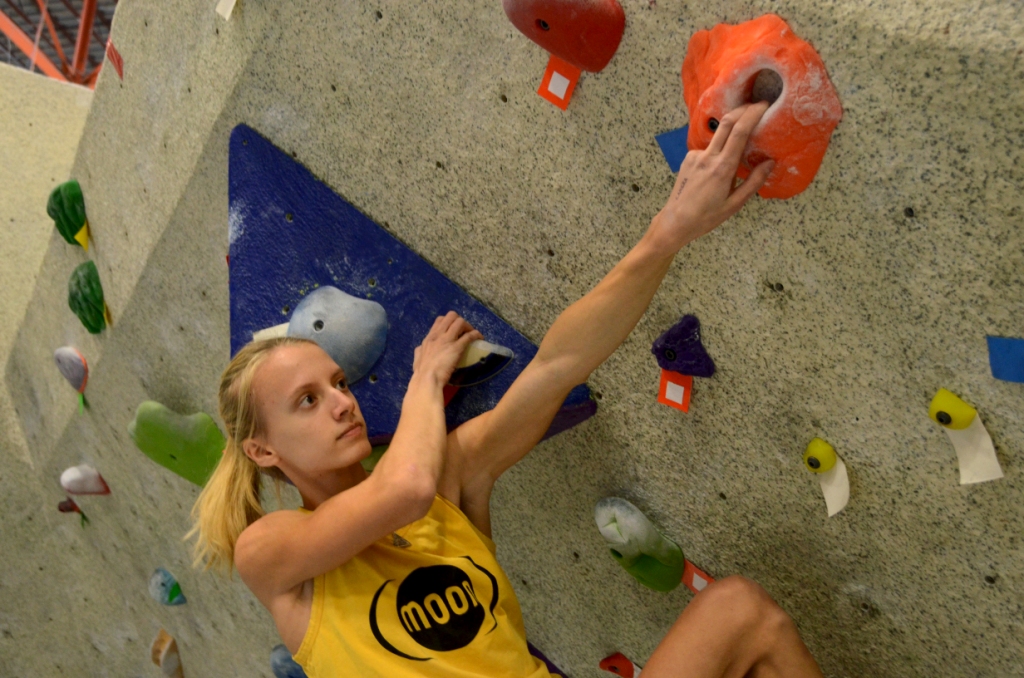
Lock-offs are the bread and butter of climbing. They are what separate the good from the great. To say they are important is an understatement. If you have ever watched a strong climber, you may have noticed that they make everything look annoyingly easy. Even their projects. That’s because they are able to go from hold to hold in a controlled manner, without the help of momentum. Locking-off refers to the action of bending your elbow just enough to reach that next hold. Although lock-offs and pull-ups involve similar muscle groups, doing straight out pull-ups won’t actually improve lock-off strength. Fortunately, this is where frenchies, uneven pull-ups, half iron crosses, and negatives come into play. All of the following exercises can be done either on a hangboard, pull-up bar, or rings.
Frenchies are modified pull-ups. Start hanging with your arms straight, pull all the way up, and lock-off for 5 seconds. Return to straight-arm position, pull all the way up, and lock off at 45° for 5 seconds. Return to straight-arm position, pull all the way up, and lock off at 90° for 5 seconds. Return to straight-arm position, pull all the way up, and lock off at 120° for 5 seconds. That makes for 1 frenchy. Start off by doing one, then see how many you can do without touching the ground.

Uneven pull-ups are exactly what they sound like. On a hangboard or campus rungs, position your hands should width apart, so that one hand is a few inches below the other. The farther apart your hands are, the greater the difficulty. Try doing these in sets of 3 to 5, locking off at the top for 3 to 5 seconds.

Half iron crosses (I call them extensions in the video) have to be done on rings. Pull all the way up, lock-off on one arm, and extend your other arm so that it is straight and parallel to the ground. Hold for 1 to 3 seconds and repeat with the other arm. Perform repetitions without touching the ground. A harder variation is to simply release the other arm, instead of extending it.

Negatives are essentially reverse one-arm pull-ups. These are harder than the other exercises, and far more stressful on the tendons, so be careful not to overdo it. On a pull-up bar or rings, pull all the way up, let one hand go, and return to straight-arm position as slowly and controlled as possible.

GRIP/CONTACT STRENGTH
Watch Ramon Julian during a Lead World Cup. As soon as his fingers come in contact with a hold, they are latched on, as if with superglue. And while it is entirely possible that the sweat glands of his palms and fingers do, indeed, excrete a superglue-like substance, this phenomenon may also be attributed to his incredible grip and contact strength. More specifically, grip strength refers to the ability to “stick” to holds statically, while contact strength involves dynamically going for and catching a hold. Deadhangs and campus rung exercises are fantastic tools for developing both.
Deadhangs involve hanging with straight (or slightly bent, as to prevent hyperextension of the elbows) arms. On a specific grip (crimp, pinch, sloper, etc.) perform sets of 5, 5-second deadhangs, with 5-second rests in between. Repeat with other grips. For greater difficulty, increase hanging time to 10 seconds or use a weight vest. You’ll be surprised by the pump factor!
Campus rungs are a genius invention. For one, they’re wooden boards. Yet somehow, they help with both lock-offs and contact strength, more so than any other training tool. Start by hanging on the rungs to get your fingers warmed up, then move on to locking off with one hand, and moving up and down with the other. Once you feel comfortable with hanging and pulling on the rungs, you can create various patterns, such as skipping one or two rungs. One of my favorite patterns involves starting with your hands one rung apart (rungs 1 and 3), then skipping two rungs, then skipping one rung. But you can come up with practically anything, and use that to build up to harder sequences.
POWER ENDURANCE
 Power endurance is to bouldering as normal endurance is to sport climbing. You need it. Especially come time for competition season, and you find yourself in the dreaded 4 minutes on, 4 minutes off situation, scrambling to get up the problem. Endurance is something that is often overlooked by boulderers, myself included, because progress isn’t as immediately visible as with strength training. Fortunately, endurance training can be (relatively) quick and painless.
Laps refer to climbing a single problem multiple times, with little or no rest in between. Pick 5 problems and climb each problem once, with a 1 minute rest in between problems. After you have climbed all 5 problems, take a 2-minute rest. Repeat 3 to 5 times, for a total of 15 to 25 laps. Conversely, you can climb a single problem 5 times, then move onto another until you have done 3 to 5 problems.
Pyramids are similar to laps, except climbs get progressively harder, then progressively easier. For instance, if you boulder V5 consistently, a pyramid would consist of V2, V3, V4, V5, V4, V3, V2, with 1 minute rests in between problems.
Let’s get training!
woaow, she's strong! Time to gett off my butt!!! :)